About 80% of people I see in clinic with tennis elbow don’t play tennis. They’re carpenters, hairdressers, painters, electricians, parents lifting toddlers all day, office workers gripping a mouse for nine hours, baristas tamping coffee. The condition gets its name because it was first described in lawn tennis players in the 1880s, but the lateral epicondyle of the elbow doesn’t care how you load it. It just cares that you’ve loaded it more than it can handle.
I grew up playing competitive tennis, took a scholarship to the University of South Carolina, played across the US, Europe and Australia, and dealt with my own elbow issues along the way. I now run shoulder and elbow rehab at MRP Health. Tennis elbow walks into the clinic every week. Most of the people I see have been managing it themselves for 6 to 18 months with some combination of rest, ice, a strap from the chemist, and increasing frustration.
Here’s what the condition actually is, why the usual approach fails, and what works.
What tennis elbow really is
The official term is lateral epicondylalgia or lateral epicondylar tendinopathy. The pain comes from the tendon attaching the wrist extensor muscles (primarily the extensor carpi radialis brevis, or ECRB) to the bony bump on the outside of your elbow.
Like plantar fasciopathy and Achilles tendinopathy, the science on this condition shifted around 2003. Histology studies (Kraushaar & Nirschl, Khan, Maffulli and others) showed that in chronic cases the tissue isn’t inflamed. It’s degenerated — disorganised collagen, microscopic tearing, neovascularisation. That’s why “tennis elbow-itis” is the wrong name. The condition is tendinopathy, not tendinitis. This matters because it changes the treatment logic completely.
You don’t fix degenerated load-bearing tissue with rest. You fix it with progressive, controlled loading. Most of what people are doing for tennis elbow does the opposite.
Who gets it and why
The peak age is 40–60. Slightly more common in women than men in some studies. About 1–3% of adults will get it in any given year. Risk factors that show up clinically and in the literature:
- Repetitive gripping or wrist extension at work — trades, hairdressers, dental hygienists, chefs, anyone doing manual fine work.
- Computer use with poor ergonomics — mouse-heavy work, especially with a poorly positioned keyboard or armrest.
- Smoking — tendons hate it.
- Diabetes and metabolic dysfunction — same.
- A sudden spike in load — a weekend of painting the house, taking up tennis at 45, gripping a power tool for hours.
- Previous tennis elbow — once you’ve had it, you’re more vulnerable.
The classic tennis player tennis elbow happens with backhand technique that puts the wrist in extension at impact — late hits, leading with the elbow, wrist breaking back through the stroke. Modern two-handed backhands have reduced this somewhat in tennis players. But that’s not who walks into the clinic.
How to know if you have it
Classic presentation:
- Pain on the outside of the elbow, sometimes radiating down into the forearm.
- Worse with gripping — turning a doorknob, lifting a kettle, shaking hands, picking up a coffee cup.
- Worse with wrist extension — opening a jar, mouse use, holding a phone.
- Often a dull ache during the day, sharp pain with specific movements.
- Tender to the touch over the lateral epicondyle.
Two clinical tests that confirm it in most cases:
- Resisted wrist extension with elbow straight — reproduces the pain.
- Resisted middle finger extension — sometimes called Maudsley’s test — reproduces the pain.
Imaging usually isn’t needed for a typical presentation. Ultrasound or MRI is reserved for cases that don’t respond to 8–12 weeks of structured rehab, or where the diagnosis is in doubt. Common differentials I rule out clinically: cervical referred pain from the C5–C7 nerve roots (a surprising number of “tennis elbows” are actually neck), radial tunnel syndrome, posterior interosseous nerve compression, lateral elbow joint pathology in middle-aged patients.
If your “tennis elbow” hasn’t responded to 6 weeks of well-done rehab, the diagnosis itself is worth revisiting.
Why the usual approach fails
Five reasons people stay stuck with tennis elbow for 12 to 24 months:
1. They rest, hoping it will heal. A tendon needs load to remodel. Rest deconditions the tissue further. Pain settles temporarily, returns the moment activity restarts, and the cycle repeats. Tendons are biologically lazy — they only adapt when you ask them to.
2. They’ve been told it’s inflammation. And so they ice, take anti-inflammatories, and wait for inflammation to clear. There’s no inflammation to clear. The tissue is degenerated. NSAIDs don’t fix degenerated tissue.
3. The strap from the chemist becomes the treatment. Counterforce braces (the strap that sits below the elbow) modestly offload the tendon and can help with symptoms during specific activities. They are not treatment. They don’t change the tissue. If you’ve been wearing one for 6 months and not progressing your loading, you’ve stalled.
4. The corticosteroid injection felt amazing for 6 weeks. And then it came back, worse. The Coombes et al. 2013 study in JAMA followed 165 patients with tennis elbow randomised to corticosteroid injection, physiotherapy, both, or placebo. At 6 weeks the steroid group was doing brilliantly. At 12 months the steroid group had worse outcomes than the placebo group. Recurrence was 54% in the steroid group vs 12% in the placebo group. Cortisone is one of the more harmful “treatments” for tennis elbow in the medium and long term. I almost never recommend it.
5. The loading was never progressive. Some patients have done exercises. Light wrist curls with a 1 kg dumbbell for three weeks. The tendon doesn’t notice 1 kg. Tendons need progressive, heavy, slow loading to remodel. Most rehab programs underdose.
What actually works — in order of evidence strength
Tier 1 — Strong evidence, do these first
Progressive heavy slow resistance loading of the wrist extensors. The protocol most-studied is the Tyler eccentric program using a “FlexBar” (a flexible rubber bar), or simply heavy slow eccentric and concentric wrist extension with a dumbbell. Three sets of 15, three to five days per week, progressively loaded. We typically build up to 4–6 kg by 12 weeks for someone with a typical case. There’s a phase of accepting some pain (≤4–5/10) during loading — pain isn’t damage in tendinopathy, and pain that settles within 24 hours is acceptable. Stahl and the Aspetar tendinopathy group have refined these protocols substantially in the last decade.
Load modification, not load avoidance. You don’t stop using the arm. You modify the loads that aggravate it. Change the mouse to a vertical mouse or trackball. Use both hands to lift the kettle. Cut the apple with a sharper knife. Take micro-breaks every 25 minutes if your job is grip-heavy. The aim is to reduce the daily aggravators while you load the tendon properly in rehab.
Specific manual therapy. Mulligan mobilisations with movement at the elbow have reasonable evidence as an adjunct in early stages, particularly for pain reduction in the first 2–4 weeks. Not a standalone treatment, but useful for getting people moving when loading is too painful.
Tier 2 — Reasonable evidence, use selectively
Cervical and thoracic spine assessment. In a meaningful subset of cases, restriction in the lower cervical or upper thoracic spine contributes to symptoms. Treating these areas often unlocks faster progress. We screen routinely.
Extracorporeal shockwave therapy (ESWT). For chronic cases (over 6 months) that haven’t responded to loading, shockwave has reasonable evidence. Three to five sessions, two weeks apart. We use it as an adjunct, not a primary treatment.
Dry needling. Limited evidence but reasonable safety. Can be useful for managing referred pain and reducing protective muscle guarding around the extensor mass.
Tier 3 — Limited or short-term only
Counterforce bracing. Modest symptom relief during specific tasks. Not curative.
Ice. Useful for pain relief after high-load days. Not therapeutic.
Ultrasound therapy. Most evidence shows it’s no better than placebo. We don’t use it.
Tier 4 — Don’t waste your time or money
Corticosteroid injections. As above — worse outcomes at 12 months. Reserved for truly intractable cases under very specific circumstances, and even then, I’d push back hard.
PRP (platelet-rich plasma). Mixed evidence at best. Expensive. Not a first or second-line option.
Surgery. Reserved for the small number of cases (under 5%) that fail 12 months of well-executed conservative care.
What I see go wrong with self-managed tennis elbow
The pattern I see most: someone’s elbow has been sore for 4–6 months. They’ve tried resting, a strap, some general wrist stretches, an anti-inflammatory cream, and maybe a single cortisone injection. They come in frustrated.
We do a 45-minute assessment. The tendon is loaded poorly during their workday — usually their mouse setup or grip-heavy task. Their wrist extensor strength is 40% lower on the affected side than the unaffected side. Their neck has restriction at C5–C6 that’s contributing referred load.
We build a progressive loading program — typically two to three exercises, done daily, progressed weekly. We modify the daily aggravators. If the neck is contributing, we treat that in parallel. We see them weekly for 4 weeks, then fortnightly, then monthly.
Most well-managed cases improve substantially in 8–12 weeks. Chronic cases (over 12 months at presentation) often take 4–6 months to fully resolve, sometimes longer. The biggest predictor of timeline isn’t severity — it’s compliance with the loading program.
Realistic recovery timeline
- Acute (under 3 months of symptoms): 8–12 weeks to substantial resolution with proper loading.
- Subacute (3–6 months): 12–16 weeks.
- Chronic (6+ months): 4–6 months, sometimes up to 9 months.
- Recurrent (a second episode): Usually faster than the first if rehab is done properly, but the rehab can’t be skipped.
These assume the loading program is actually done. The number-one reason cases don’t resolve in clinic is non-adherence to the home program.
What we do at MRP Health
A tennis elbow assessment with me includes:
- History (onset, aggravators, occupation, hobbies, previous episodes, medication, smoking, diabetes, metabolic health)
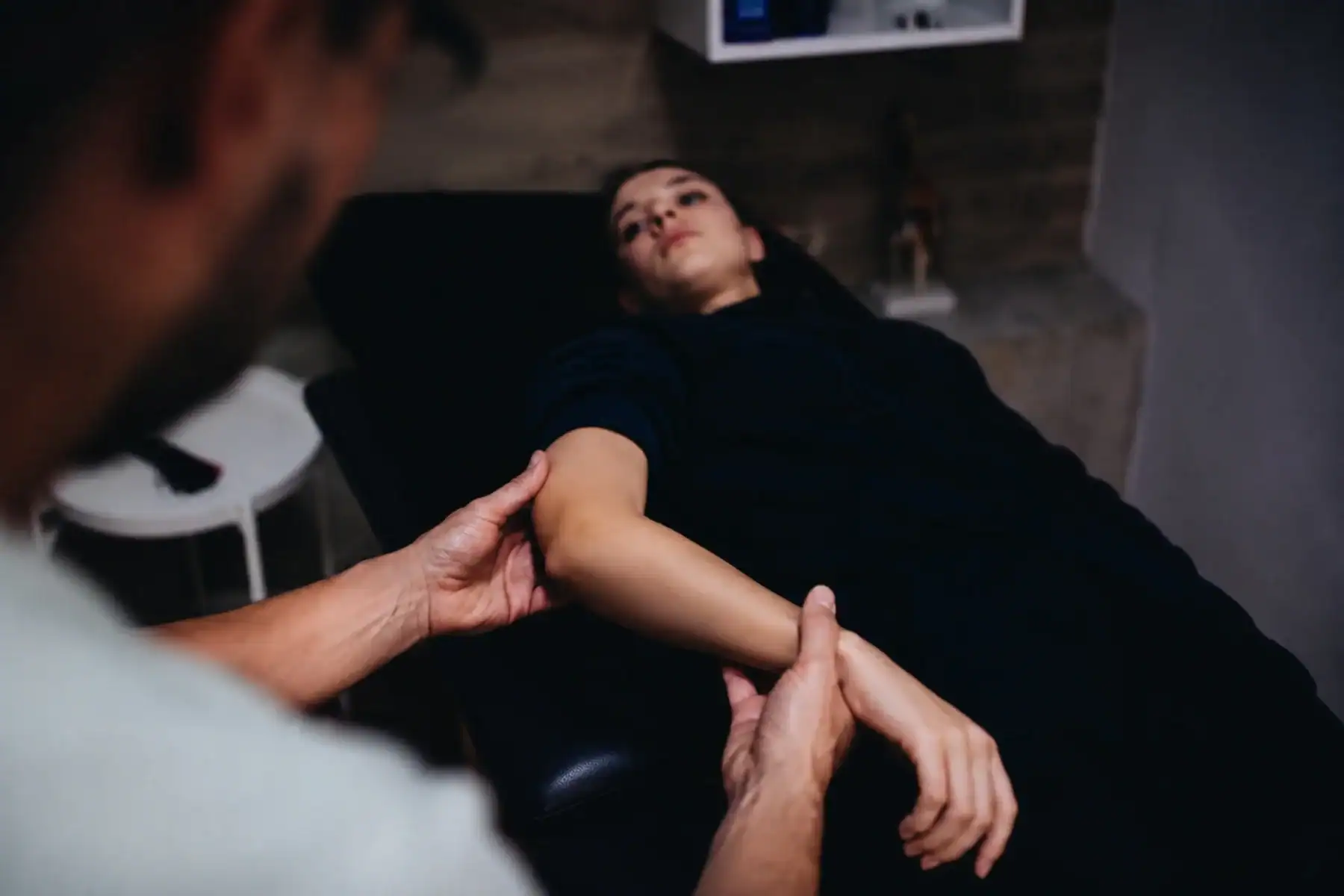
- Examination of the elbow, wrist, forearm, shoulder, cervical and thoracic spine
- Strength testing of wrist extensors (handheld dynamometer) for objective baseline
- Diagnostic confirmation
- A specific 12-week loading program demonstrated in clinic and progressed at follow-ups
- Workstation/task modification advice
- Manual therapy as adjunct where indicated
- Imaging or referral if conservative care plateaus
If your case has a significant grip component (tradies, manual workers), I’ll also work with you on grip ergonomics and tool selection. If you actually play tennis, we’ll review technique at some point — usually with a video review and sometimes a coach referral.
If your “tennis elbow” turns out to be neck or radial tunnel rather than tendinopathy, the treatment changes. We catch this in assessment.s.
Frequently Asked Questions
Acute cases caught early: 8–12 weeks with proper loading. Chronic cases (over 6 months of symptoms): 4–6 months, sometimes longer. The variable that matters most is whether you actually do the progressive loading program. Patients who skip exercises take 2–3 times longer.
No. Rest deconditions the tendon further. You modify the loads that aggravate it — change your mouse, lift with two hands, take grip breaks — but you don’t stop using the arm.
A counterforce strap offloads the tendon during specific activities and can provide symptomatic relief. It’s not curative. If you’ve been wearing one for 3 months without progressing rehab, you’ve stalled.
Almost never. Excellent for 6 weeks of relief. At 12 months, cortisone-injected patients have worse outcomes than placebo and a 4× higher recurrence rate (Coombes et al. 2013, JAMA). Reserved for very specific situations.
Often yes, with modifications. Pain ≤4/10 during, no spike in pain the next day, no progression of symptoms — usually we can keep you playing. Sometimes we modify (no serving for 3 weeks, lighter racket for a period). Stopping entirely isn’t usually necessary or helpful.
The counterforce strap (the band that sits below the elbow) is the most-evidenced option for symptomatic relief during activity. Wrist splints rest the tendon but don’t load it, so they’re useful only for very acute high-pain phases.
About 1 in 8 “tennis elbow” cases I see have a significant contribution from the neck or from the radial nerve. If your rehab has plateaued, this is worth checking.